Every space you read, as a folder on your laptop.
Link a computer with a one-time code, and each space you read lands in
~/instibrain as plain markdown, kept in step. The computer makes its own keys;
our server holds only their public halves.
One code and one install line link a computer.
On a Mac, Linux, or Windows, the installer brings Node and Claude Code when the computer has none, and links every space you read. Run it again to update the sync client, or to go on after a stop. Those two downloads carry no checksum of their own.
- in the cockpit
A code
It works once, for ten minutes.
Devices, Link a computer - on the computer
One line
The installer, in a terminal or PowerShell.
Mac, Linux, Windows - in a second
Its own keys
Made on the machine; public halves go up.
three keypairs - in two minutes
Every space
A folder each, then Claude Code, then ready.
the check says ok
Every computer gets the same folder, so every AI starts the same way.
Claude Code opens in ~/instibrain and reads instibrain's rules, then yours,
then the space it works in.
- CLAUDE.mdImports the system, then you. The AI opens here.
- system/instibrain's own rules, read-only, the same for everyone.
- spaces/A folder per space you read. Plain markdown.
- personal/Your layer, read on every computer you link.
- sealed/Opens here, with the key in this computer.
- acme/The company's space, and its
rules/policy/. - specialists/Each specialist you read.
- ~/.claude/Claude Code's own folder.
- agents/The curator, the guard, the builder, and each specialist, as subagents.
- three hooksSave check before a write, structure check after, team rules per prompt.
- DesktopTwo buttons: instibrain opens a menu of a fresh session, a resumed one, the spaces folder, and each specialist; Memory opens the folder.
The sync client never writes over your work.
It runs at login and syncs after each burst of edits, and as soon as a teammate's change reaches the brain. On a Mac and on Linux it is a background service; on Windows a keeper starts it at each sign-in and again after a failure. On Linux it stops at logout unless you turn on linger.
Your own text never comes back as a conflict copy, even when a push's answer was lost. When two people changed the same page, yours stands, the brain's copy lands beside it, and your AI merges them. Set one variable, and each cycle commits the folder to your own git.
You see every link, and you revoke a lost laptop in one click.
We never hold a private key. Any program running as you can read the key file, so revoke a lost laptop at once.
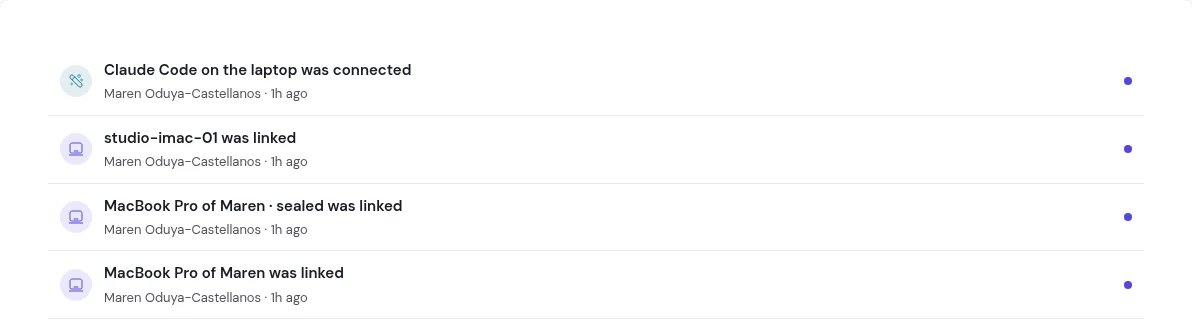
Every new link reaches your notifications.
Each names the computer or AI, who linked it, and when. On Devices, one click revokes a lost laptop, and its sealed spaces get new keys.
Your laptop holds the pages your AI reads, as plain files.
Grep them, open them in any editor, and keep them if you leave.